A Tibet Tour from Shanghai is easier to plan when you stop thinking of Shanghai as just the city you leave behind.
For many international travelers, Shanghai can be the first part of the journey. You might spend a few days there after arriving in China, then head west to Tibet. The change is quite dramatic: from a crowded coastal city to Lhasa, where the altitude is around 3,650 metres and even a normal walk can feel different.
The distance also changes the way you should plan the trip.
If you have only a week, I would keep the Tibet route short and fly. If you have two weeks or more, the Shanghai–Lhasa train becomes a reasonable choice for someone who enjoys long-distance rail travel. And if Everest or Mount Kailash is on your list, I would plan the Tibet route first and fit Shanghai around it.
I’m Tsering Pema, a local Tibetan and part of the team behind CHIBET Travel. Our work is mainly about helping travelers understand Tibet before they arrive: which route makes sense, how much time to allow, what the altitude means, and how a China gateway such as Shanghai fits into the bigger journey.
For this kind of trip, I find that starting with the destination works better than starting with the ticket.
Think About the Whole Journey, Not Just Shanghai to Lhasa
There are plenty of ways to get from Shanghai to Lhasa.
That is not the difficult part.
The more useful question is what you want to do once you reach Tibet.
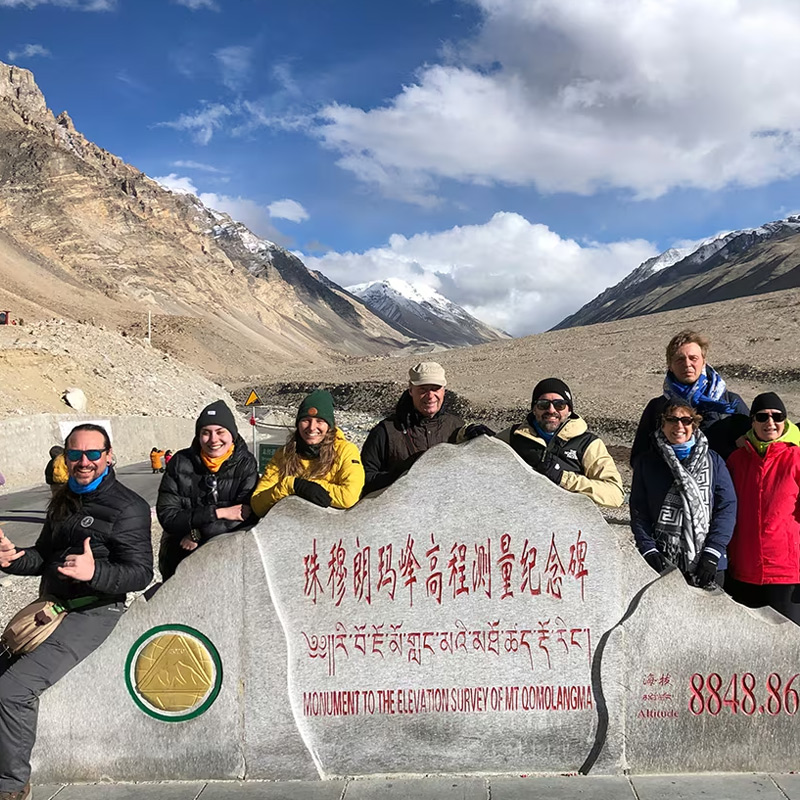
A traveler who wants to see Lhasa, Yamdrok Lake and return to Shanghai needs a very different schedule from someone who wants to continue toward Everest Base Camp.
And Mount Kailash is another matter altogether.
For example:
Short first trip
Shanghai → Lhasa → Yamdrok Lake → Lhasa
Longer central Tibet trip
Shanghai → Lhasa → Yamdrok Lake → Shigatse → Lhasa
Everest trip
Shanghai → Lhasa → Shigatse → Everest Base Camp → Lhasa
Western Tibet journey
Shanghai → Lhasa → Shigatse → western Tibet → Mount Kailash → return
The map can make these places look like stops that can simply be added one after another. In reality, road distances, altitude and the time needed to travel through Tibet make a big difference.
That is why I would decide on the Tibet route before choosing between the Shanghai–Lhasa train and a flight.
How Much Time Should You Give the Trip?
Your total holiday time matters more than the distance between Shanghai and Tibet.
If you have seven or eight days, I would not try to cover half of Tibet. Spend a little time in Shanghai, fly to Lhasa and keep the Tibet section straightforward.
With ten to eleven days, you can have a more comfortable first look at Lhasa and nearby places.
At twelve to fourteen days, the trip starts to open up. You have room for a longer central Tibet route or an excursion toward Everest, depending on the exact itinerary.
If you have more than two weeks, you can think about the train without sacrificing too much of your Tibet time.
| Total trip length | A realistic approach |
|---|---|
| 7–8 days | Shanghai + a short Lhasa-focused Tibet trip |
| 9–11 days | Shanghai + Lhasa + nearby destinations |
| 12–14 days | Shanghai + central Tibet or a longer overland route |
| 15–18 days | Shanghai + Everest or a deeper Tibet itinerary |
| 18+ days | Longer western Tibet or Kailash-focused journey |
These are planning ranges, not fixed tour rules.
A traveler who has already visited Shanghai may prefer to spend only one day there. Someone arriving in China for the first time may want three or four days.
The Tibet side should not be shortened simply to give Shanghai more space.
Shanghai Can Be Part of the Story
This is one reason I like the Shanghai starting point for international travelers.
You can begin with a few ordinary China days before dealing with altitude.
Walk along the Bund. Eat something local. Get over the jet lag. Spend time in a neighborhood rather than trying to turn every hour into sightseeing.
Then fly west.
When you arrive in Lhasa, the pace changes almost immediately. The air is thinner, the sunlight is stronger and your first concern should be how your body feels, not how many attractions you can check off.
That contrast is part of what makes a Shanghai–Tibet itinerary interesting.
It does not need a grand explanation.
The two places simply feel very different.
Choosing the Right Way to Reach Lhasa
There are two practical choices from Shanghai: train or flight.
The right one depends mainly on your available time and whether you see the railway as part of the trip.
Take the Train If the Journey Matters to You
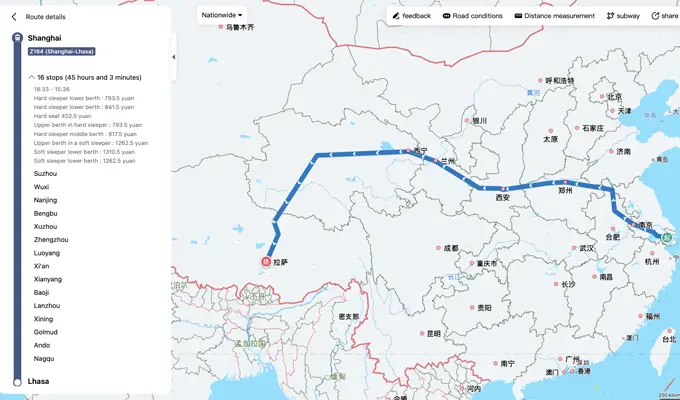
The direct Shanghai–Lhasa train takes roughly 45 hours. Current train schedules and ticket availability should be checked for your travel date through China Railway 12306, because published services and availability can change.
Forty-five hours is a long time.
That sounds obvious, but it is worth saying because some travelers look at the train as if it were simply a slower flight.
It is not.
You spend two nights on the railway. You watch the scenery change. You have time to read, sleep, eat, walk around the train and simply let the journey unfold.
For someone who enjoys trains, that can be a good part of the holiday.
For someone who has ten days and wants to see Everest, those same two days may be better spent in Tibet.
For a journey this long, I would choose a sleeper rather than a seat. A hard sleeper is the more economical option; a soft sleeper is more comfortable if you prefer a little more privacy.
Fly If Tibet Is the Main Event
Flying is the practical choice when you want to protect your Tibet days.
Current Ctrip listings show that Shanghai–Lhasa flight options vary by date, with connecting itineraries appearing on some travel dates. Flight prices and connection times can change considerably, so it is better to compare the actual dates of your trip than to use one fixed fare as a reference.
When comparing flights, I would look at more than the cheapest ticket.
- Total travel time
- Direct or connecting service
- Connection airport
- Connection duration
- Departure airport in Shanghai
- Arrival time in Lhasa
- Baggage allowance
A flight that costs a little more but gets you to Lhasa earlier and with fewer complications can be the better choice for a Tibet tour.
A Useful Middle Ground: Train One Way
There is a third possibility that suits some travelers very well.
Take the train to Tibet and fly back.
This gives you the railway experience without making the return journey another two-day train trip.
I particularly like this arrangement for travelers who have enough time to enjoy the train but know that they may be tired after finishing a long Tibet overland route.
You could also reverse it.
The better direction depends on your international flight, available train dates and the rest of your itinerary.
The important point is not to force the train into the trip simply because you have heard that everyone should experience the Qinghai–Tibet Railway.
If you love trains, take it.
If you do not, there is no need to spend two days on one.
What a 10-Day Tibet Tour from Shanghai Could Look Like
Ten days is enough for a pleasant first trip, but I would resist the temptation to add every famous place.
A simple version could be:
Day 1: Arrive in Shanghai
Day 2: Shanghai sightseeing
Day 3: Shanghai sightseeing
Day 4: Fly Shanghai → Lhasa
Day 5: Rest and acclimatization in Lhasa
Day 6: Lhasa sightseeing
Day 7: Lhasa sightseeing
Day 8: Yamdrok Lake day trip
Day 9: Lhasa / flexible day
Day 10: Departure
There is nothing wrong with an itinerary like this.
It gives you time to see the main sights in Lhasa without immediately turning the trip into a long-distance road journey.
If you have only ten days, I would choose this over trying to squeeze in Everest.
A 14-Day Version Gives You More Room
With fourteen days, you can start moving beyond Lhasa.
For example:
Days 1–2: Shanghai
Day 3: Fly Shanghai → Lhasa
Day 4: Lhasa acclimatization
Days 5–6: Lhasa sightseeing
Day 7: Lhasa → Yamdrok Lake → Shigatse
Day 8: Shigatse
Day 9: Shigatse → Everest area
Day 10: Everest Base Camp area
Day 11: Return toward Shigatse
Day 12: Shigatse → Lhasa
Day 13: Lhasa
Day 14: Departure
The exact overnight stops can change according to the route, road conditions and current travel arrangements.
What matters is the shape of the journey.
You spend enough time in Lhasa before going higher and farther west.
Everest Changes the Trip
If Everest Base Camp is the reason you want to visit Tibet, plan around Everest rather than treating it as an optional afternoon excursion.
The journey from Lhasa toward the Everest area involves long road travel and higher elevations. You need enough time for acclimatization before reaching the higher parts of the route.
This is particularly important when you have just flown from Shanghai.
Your body has moved from close to sea level to around 3,650 metres in a matter of hours.
I would rather see someone spend an extra quiet morning in Lhasa than arrive at a high-altitude destination exhausted because the itinerary looked better on paper.
For an Everest-focused Tibet Tour from Shanghai, twelve to fourteen days is a much more sensible starting point than trying to do everything in one week.
Mount Kailash Needs a Different Plan
Mount Kailash should not be treated as another item to add to a short Shanghai–Tibet holiday.
The journey into western Tibet is long. The altitude becomes higher, the roads become more remote and the kora around Mount Kailash requires its own time and physical preparation.
If Kailash is your main goal, I would first build the Tibet itinerary around the pilgrimage.
Then add Shanghai before or after it.
That may mean a trip of eighteen days or more.
It is better to spend those extra days properly than to turn a major pilgrimage route into a rushed extension of a city tour.
What About Taking the Train from Shanghai for Acclimatization?
You will often hear that taking the train is better because you gradually gain altitude.
There is some logic to that, but I would not plan a Tibet tour around this idea alone.
The train does spend a long time moving toward the plateau, but you still arrive in Lhasa at high altitude. The journey itself can also be tiring because you are sleeping on a train for two nights.
So I would describe the train as a travel experience that may make the transition feel more gradual, not as a replacement for proper acclimatization in Tibet.
Whether you arrive by train or plane, your first days in Lhasa still deserve a slower schedule.
What Should You Do in Your First Two Days in Lhasa?
Not very much.
That is probably the hardest advice for an enthusiastic traveler to follow.
After a long journey, you may want to visit the Potala Palace immediately, walk around Barkhor and stay out all evening.
Give yourself some flexibility.
A relaxed first day can mean:
- Checking into the hotel
- Eating a simple meal
- Taking a short walk if you feel comfortable
- Drinking enough water
- Sleeping
- Seeing how your body responds
The next day can be used for sightseeing if you are feeling well.
Tibet is not a place where you gain anything by pretending altitude does not affect you.
What Permits Do Travelers from Shanghai Need?
Starting your trip in Shanghai does not change the travel requirements for entering Tibet.
Foreign travelers need the applicable Tibet Travel Permit before entering the Tibet Autonomous Region. Additional permits may be required for certain areas and routes.
For example, an Everest itinerary and a Mount Kailash itinerary involve different planning requirements from a simple Lhasa stay.
The permit process should therefore be considered together with your route.
CHIBET can help you understand which travel requirements are relevant to your proposed itinerary and coordinate your enquiry with a licensed Tibet operating partner.
The licensed operating partner handles the formal permit processing and the on-the-ground operation of the booked tour.
CHIBET’s role is to help you understand the options and plan the journey.
What Should You Book First?
I would work through the trip in this order.
1. Decide the Total Number of Days
Count the whole China trip, not just the Tibet section.
2. Decide What Tibet Means to You
Is it Lhasa?
Everest?
A longer overland route?
Mount Kailash?
This answer affects everything else.
3. Decide How Much Shanghai You Want
Two days may be enough for one traveler.
Four days may be better for someone seeing Shanghai for the first time.
There is no need to use the same number for everyone.
4. Choose Train or Flight
Only after you know the route and number of days.
5. Check Current Transport Information
For trains, use China Railway 12306 for the actual travel date.
For flights, compare current Shanghai–Lhasa options on Ctrip.
6. Plan the Tibet Travel Requirements
Make sure the necessary travel documents and route-specific arrangements are understood before the trip is fixed.
7. Leave Some Space
This matters more in Tibet than in many ordinary city tours.
A day with less planned can be useful if your body needs it or the road takes longer than expected.
Is Shanghai a Good Starting Point for a Tibet Tour?
For international travelers, yes.
It is especially useful if Shanghai is already part of your China trip.
You do not need to choose between “Shanghai trip” and “Tibet trip.”
They can work together.
The trick is not to make Shanghai so long that Tibet becomes an afterthought.
If Tibet is the main reason you came to China, I would protect the Tibet days first.
If you have already visited Tibet before and want to spend more time in Shanghai, the balance can be different.
There is no universal itinerary.
Who Should Take the Shanghai–Lhasa Train?
I would recommend the train to travelers who:
- Have at least twelve to fourteen days
- Enjoy long-distance train travel
- Want to see the landscape change gradually
- Are interested in the Qinghai–Tibet Railway
- Do not mind spending two nights on the train
- See the journey itself as part of the holiday
I would lean toward flying if you:
- Have less than ten days
- Want to visit Everest
- Want to spend more time in Tibet
- Do not particularly enjoy long train journeys
- Need to match a tight international flight schedule
Neither choice is more “correct.”
It depends on what you want your holiday to contain.
A Practical CHIBET View
When someone asks me about a Tibet Tour from Shanghai, I do not think the first question should be “train or flight?”
I would ask:
What do you want to see in Tibet?
Then:
How many days do you have?
After that, the transport decision becomes much easier.
This is also how we approach China and Tibet travel at CHIBET.
We are not trying to make every traveler use the same route. Our role is to help you compare the practical choices, understand Tibet better and work out how your China gateway connects with the Tibet journey.
If you send us your travel dates, number of travelers, total days and the places you are considering, we can help you look at the route before you commit to the details.
When you decide to arrange the Tibet tour, your enquiry can be introduced to our licensed Tibet operating partner. The operating partner handles the formal travel contract, payment, required permits, bookings and on-the-ground operation.
That division of roles is deliberate.
Our strongest expertise is Tibet, and we help travelers make sense of the journey before the formal arrangements are made.
The Main Thing to Remember
A Tibet Tour from Shanghai does not need to be complicated.
Give Shanghai the amount of time it deserves.
Give Lhasa time for acclimatization.
Do not underestimate the distances inside Tibet.
And choose the train because you want the railway experience, not because you feel you are supposed to take it.
If you have ten days, fly and keep the Tibet route focused.
If you have two weeks, you have more choices.
If Everest matters, add the days.
If Kailash matters, build the whole trip around it.
The best Shanghai–Tibet itinerary is not the one with the longest list of places.
It is the one where the number of days, the transport and the Tibet route actually fit together.
Frequently Asked Questions
Frequently Asked Questions About Tibet Tours from Shanghai
How do I plan a Tibet Tour from Shanghai?
Start with your total travel time and the Tibet destinations you want to visit. Then decide how much time to spend in Shanghai and whether the train or flight makes more sense for the route.
How long does the Shanghai to Lhasa train take?
The direct Shanghai–Lhasa train takes roughly 45 hours. Check China Railway 12306 for the current timetable and ticket availability for your travel date.
Is there a direct train from Shanghai to Lhasa?
Yes. A direct Shanghai–Lhasa service is available, with a journey of roughly 45 hours. Exact schedules should be checked on 12306 for your travel date.
Is it better to fly or take the train from Shanghai to Tibet?
For a short holiday, flying usually makes more sense because it protects your Tibet sightseeing days. The train is more suitable if you have enough time and genuinely want the railway journey to be part of the trip.
Can I take the train to Tibet and fly back?
Yes. Taking the Shanghai–Lhasa train one way and flying the other can be a useful compromise for travelers who want to experience the railway without spending another two days on the return journey.
How many days do I need for a Tibet Tour from Shanghai?
About 9–11 days can work for Shanghai, Lhasa and nearby destinations. Around 12–14 days gives you more flexibility, while Everest and Mount Kailash require longer itineraries.
Can I visit Everest on a Tibet Tour from Shanghai?
Yes. Everest requires additional travel days after arriving in Lhasa, so I recommend a longer itinerary rather than trying to add it to a short Shanghai–Tibet trip.
Can I visit Mount Kailash from Shanghai?
Yes, but Mount Kailash needs a much longer Tibet itinerary because of the long overland journey, high altitude and three-day kora. It should be planned as a major part of the trip rather than a short extension.
Does taking the train help with altitude acclimatization?
The train provides a slower transition toward the plateau, but it should not be treated as a substitute for acclimatization in Tibet. Whether you arrive by train or plane, allow time to adjust in Lhasa.
Do foreigners need a Tibet Travel Permit from Shanghai?
Yes. Foreign travelers need the applicable Tibet Travel Permit before entering the Tibet Autonomous Region. Additional permits may be required for specific destinations.
Can I travel independently from Shanghai to Tibet?
Shanghai can be explored independently, but the Tibet portion has specific travel requirements for foreign visitors. The required travel arrangements and permits need to be organized before entering Tibet.
Is Shanghai a good gateway for Tibet?
Yes. Shanghai works particularly well for international travelers who want to combine a major Chinese city with a Tibet journey. It also gives travelers the choice between a long-distance train experience and faster air travel.
When is the best time to travel from Shanghai to Tibet?
The best time depends on your Tibet route. For a first trip focused on Lhasa and central Tibet, the warmer months are generally convenient. Everest and western Tibet require more attention to seasonal road and weather conditions.
Can CHIBET help plan a Tibet Tour from Shanghai?
Yes. CHIBET can help you compare routes, train and flight options, travel time, acclimatization considerations and different Tibet tour structures. Your enquiry can then be introduced to a licensed Tibet operating partner for the formal arrangements and on-the-ground operation.