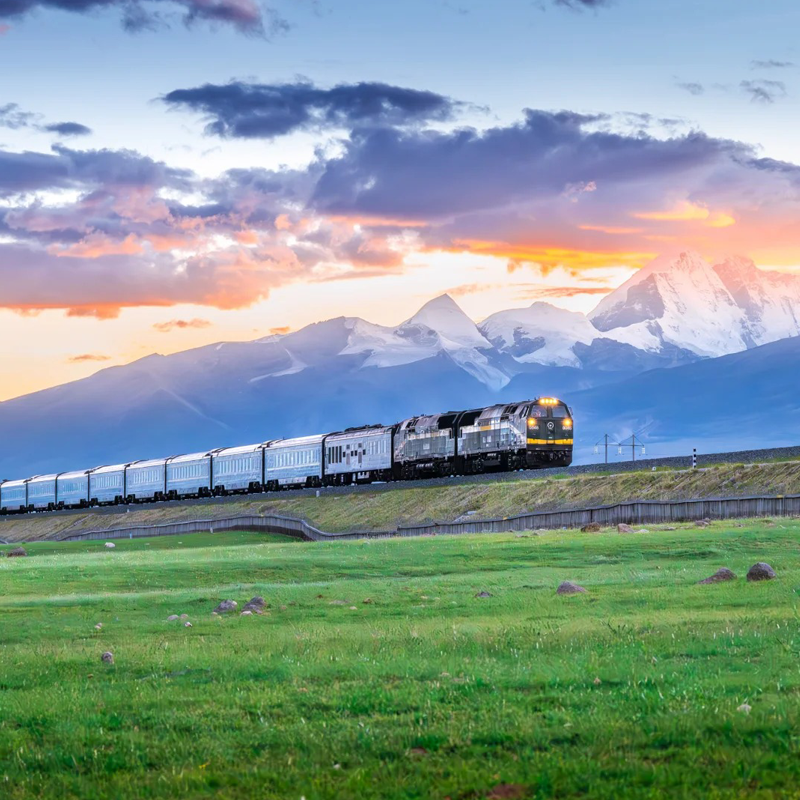
Chengdu is the most practical gateway to Tibet for most international travelers. It is the only city that gives you three real options at once: a direct train, the widest choice of flights to the plateau, and the start of the G318 Sichuan–Tibet Highway.
If you have 12 days or more and want the plateau to unfold gradually, take the train in and fly out. If your holiday is under 10 days, fly both ways and spend the saved days acclimatizing instead. The train costs less, the flight buys time, and the G318 is a tour in its own right rather than a transfer.
This page covers the Chengdu decision only. For the whole trip — days, budget, permits and booking order — start with how to plan a Tibet tour.
Chengdu to Tibet Quick Facts
Sources: China Railway 12306 passenger timetable for Z322 (Chengdu West–Lhasa) and Ctrip rail and flight listings; Civil Aviation Administration of China and Tibet Autonomous Region airport records for Lhasa Gonggar (3,570 m), Nyingchi Mainling (2,949 m), Shigatse Peace (3,782 m) and Ngari Gunsa (4,274 m); Ministry of Natural Resources standard map service for the G318 alignment. Times, fares and airport figures checked October 2026 — confirm your own travel date on 12306 and with your airline before booking.

Which Chengdu to Tibet Route Fits Your Trip?
Before you compare prices, decide which of the three routes matches how you actually want to spend your holiday. Each one trades a different currency: money, time, or comfort.
The table below uses the same six fields across every option, so you can compare them side by side rather than hop between sections.
| Option | International access | China experience | Flight | Train | Time cost |
|---|---|---|---|---|---|
| Fly Chengdu to Lhasa | Best — most international carriers into CTU/TFU | Pandas, Sichuan food, 1–2 days | 2 h 10–2 h 25 min, 20+ daily | Not used | Lowest: half a day |
| Train Z322 to Lhasa | Good — fly into Chengdu first | Pandas, Sichuan food, 1–2 days | Not used | 34 h 38 min, every other day | High: 2 full days |
| G318 overland to Lhasa | Good — fly into Chengdu first | Pandas plus eastern Tibetan plateau | Not used | Not used | Highest: 7–10 days |
| Fly to Nyingchi instead | Best — same Chengdu airports | Pandas, Sichuan food, 1–2 days | 1 h 45 min–2 h 25 min, daily year-round | Not used | Lowest: half a day |
Best for: the flight suits short holidays and older travelers; the train suits first-time visitors who want the crossing itself; the G318 suits repeat visitors and photographers; Nyingchi suits anyone worried about altitude.

Who This Route Suits — and Who It Does Not
| Traveler | Verdict | Why |
|---|---|---|
| First trip to Tibet, 12–14 days | Excellent fit | Train in, fly out gives you the plateau crossing and full time in Lhasa, Shigatse and Everest Base Camp |
| Total holiday under 10 days | Fits, but fly both ways | Two days on the train would consume a fifth of your trip |
| Traveling with parents or children | Fly into Nyingchi | Arriving at 2,949 m rather than 3,570 m gives a gentler first night |
| Wanting pandas and Sichuan food | Excellent fit | Chengdu is the single best place in China to combine both with a Tibet departure |
| Wanting the shortest possible route to Lhasa | Look at Xining instead | Xining sits on the Qinghai–Tibet Railway itself, so you board at the start of the plateau line |
| Wanting no fixed itinerary at all | Does not fit | Foreign travelers need a licensed guide and a fixed itinerary in the Tibet Autonomous Region |
If Chengdu turns out not to be the right fit — because you want the shortest rail approach, or you are building Tibet into a longer China route — compare it against the other entries in best city to enter Tibet from China before you book flights.
Train, Flight or G318: The Three Routes in Detail
Chengdu to Lhasa by Train: The Z322
The Z322 is the direct service from Chengdu West Station to Lhasa, and it is the only direct rail link between the two cities. It runs every other day, departs in the evening and reaches Lhasa on the third calendar day — 34 hours 38 minutes on board, over roughly 3,070 km. Because there is only one departure every two days, book as early as your permit allows.
At Guangyuan the train number changes from Z322 to Z323 and stays Z323 for the rest of the run. That is normal, not a missed connection: you stay on the same train.
| Station | Arrive | Depart | Altitude |
|---|---|---|---|
| Chengdu West (成都西) | — | 20:46, Day 1 | 500 m |
| Guangyuan (广元) | 02:04, Day 2 | 02:38, Day 2 | 900 m |
| Lanzhou (兰州) | 08:20, Day 2 | 08:40, Day 2 | 1,520 m |
| Xining (西宁) | 11:22, Day 2 | 11:42, Day 2 | 2,200 m |
| Delingha (德令哈) | 15:28, Day 2 | 15:34, Day 2 | 2,982 m |
| Golmud (格尔木) | 17:55, Day 2 | 18:20, Day 2 | 2,780 m |
| Lhasa (拉萨) | 07:24, Day 3 | — | 3,650 m |
| Berth class | Fare (CNY) | Notes |
|---|---|---|
| Hard seat | 302.5 | Not recommended for a two-night run |
| Hard sleeper, upper / middle / lower | 627.5 / 645.5 / 663.5 | Standard choice; six berths per bay |
| Soft sleeper, upper / lower | 997.5 / 1,034.5 | Four berths per compartment; sells out first |
Timetable and fares for Z322/Z323 are the published Chengdu West–Lhasa rates checked in October 2026. Fares are the base seat price and shift with the season and with the day of travel, and the service runs on alternating days rather than daily, so confirm your exact date and price on the official 12306 site before you plan a permit application around it.
One point travelers routinely get wrong: the train is not altitude protection. The carriages are oxygen-enriched, but you still step out at 3,650 m in Lhasa after two nights of broken sleep. Treat the ride as the plateau experience it is, and plan the same acclimatization you would after a flight.
For berth classes, the full plateau timetable and the Tanggula crossing, see our Tibet train guide.
Chengdu to Lhasa by Flight
Chengdu has more flights to Tibet than any other mainland city, serving four plateau airports. Which one you fly into shapes your first three days more than most travelers expect.
| Airport | Altitude | Flight time from Chengdu | Best for |
|---|---|---|---|
| Lhasa Gonggar (LXA) | 3,570 m | 2 h 10–2 h 25 min | Standard Tibet tours; 20+ departures a day |
| Nyingchi Mainling (LZY) | 2,949 m | 1 h 45 min–2 h 25 min | Gentler altitude; peach blossom season |
| Shigatse Peace (RKZ) | 3,782 m | About 2 h 35 min (06:35–09:10) | Shigatse and Everest routes; one daily service |
| Ngari Gunsa (NGQ) | 4,274 m | Via Lhasa or Kashgar | Kailash and western Tibet; no Chengdu nonstop |
Lhasa Gonggar sits about 60 km from central Lhasa, and the airport shuttle takes roughly an hour. Chengdu serves it from both Shuangliu (CTU) and Tianfu (TFU), and it is the only one of the four that has a genuinely dense schedule — more than twenty departures a day across Air China, Sichuan Airlines, Tibet Airlines, China Eastern and Shenzhen Airlines.
Nyingchi Mainling is the lowest airport in Tibet and the gentlest arrival point for anyone worried about altitude sickness, and it is served daily from Chengdu all year rather than only in peach-blossom season. Shigatse Peace handles few scheduled services and the timetable shifts often, so most travelers fly to Lhasa and continue by road or rail. Ngari Gunsa has no Chengdu nonstop at all: you reach it via Lhasa or Kashgar, and because it sits at 4,274 m it is used almost exclusively for Kailash itineraries booked as a full package.
For the full comparison of plateau airports, including connections from other Chinese cities, see our Tibet airport map.
Chengdu to Lhasa by Road: The G318 Sichuan–Tibet Highway
The G318 runs from Chengdu through Kangding, Litang, Batang and Chamdo before joining the main highway to Lhasa. The drive is roughly 2,290 km and takes seven days at a comfortable pace, and most people build in a rest day at Litang or Batang.
This is not a transport option. It is a tour, and it requires a private vehicle, a driver and a licensed guide from the moment you enter the Tibet Autonomous Region. Foreign travelers cannot self-drive in Tibet. Most agencies run it as a 10-day package. For the official base map of the corridor and the border alignment it follows, see the Ministry of Natural Resources standard map service.
| Section | Distance | Driving time | Highlights |
|---|---|---|---|
| Chengdu to Kangding | 330 km | 5–6 h | Erlang Mountain, Luding Bridge |
| Kangding to Litang | 290 km | 7–8 h | Tagong Grassland, Xinduqiao |
| Litang to Batang | 250 km | 6–7 h | Haizi Mountain, Sisters Lakes |
| Batang to Chamdo | 360 km | 9–10 h | Jinsha River crossing into Tibet |
| Chamdo to Lhasa | 1,060 km | 3–4 days | Nyingchi, Basum Tso, Lhasa |
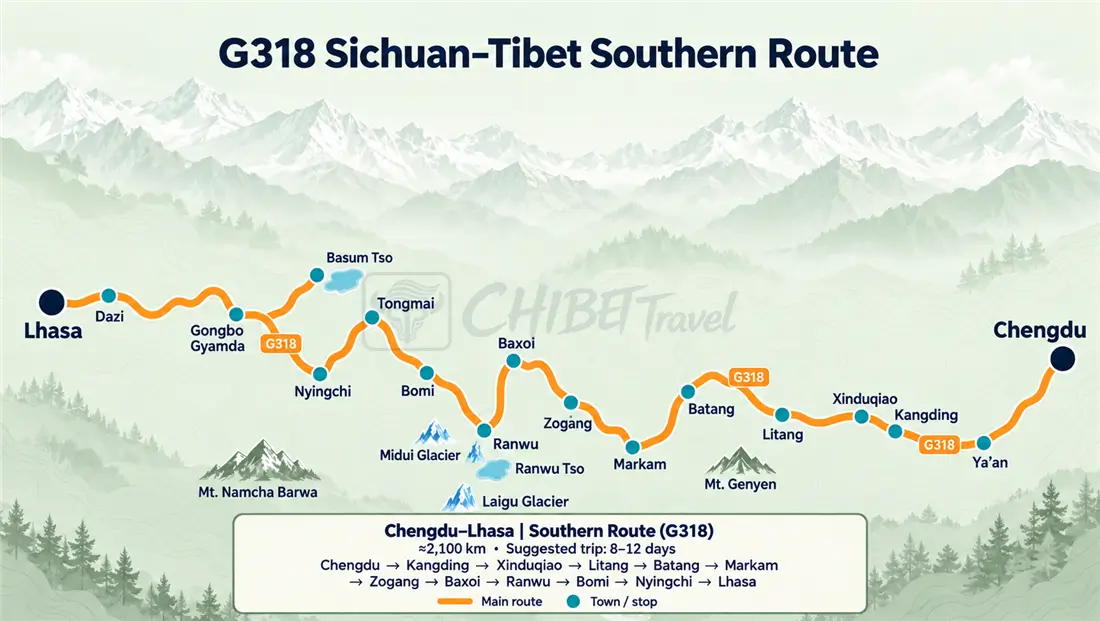
For the full road network east of Lhasa, including alternative approaches, see our Tibet road map.
Permits and Altitude: What Changes Your Plan
Every foreign traveler needs a Tibet Travel Permit, and you cannot apply for it yourself — a licensed Tibetan agency submits it on your behalf, and it is issued only once your full itinerary, guide and vehicle are confirmed. Applications are normally accepted 20 to 30 days before arrival, and the queue is longer in peak season. If your trip depends on a specific train date, start the paperwork as soon as your international flights are booked.
A standard Lhasa itinerary needs the Tibet Travel Permit alone. Traveling beyond Lhasa to Shigatse, Everest Base Camp, Ngari or Nyingchi adds the Alien’s Travel Permit, and some restricted areas require a further border permit. A Kailash route needs the full chain including a Military Permit, because it crosses restricted western areas, and the whole process takes longer.
On altitude, the practical rule is the same whether you fly or ride the train: protect your first 48 hours. Sleeping at 3,650 m on your first night in Lhasa is the single biggest variable in how the rest of your trip feels.
For the complete document checklist and the booking sequence, see our Tibet Travel Permit guide. For acclimatization planning, including where to build rest days into a route, see Tibet altitude map.
Days Needed and Trade-offs
Twelve days is the length most travelers settle on, because it is the shortest trip that covers Chengdu, Lhasa, Shigatse and Everest Base Camp without rushing. The real decision is how to fill the front of it.
Option A: Train In, Fly Out — 12 Days
Take the Z322 from Chengdu West Station and arrive in Lhasa after two nights on board. Spend three days in Lhasa, then drive to Shigatse and Everest Base Camp. Fly from Lhasa back to Chengdu. The train absorbs two days of your holiday, and in exchange you cross the plateau in slow motion instead of overflying it.
Option B: G318 Overland In, Fly Out — 12 to 14 Days
Drive the G318 from Chengdu to Lhasa over seven to eight days, stopping at Kangding, Litang and Nyingchi, then fly out of Lhasa. This version costs more, is physically harder, and needs more permit lead time, but it is the only way to see eastern Tibet properly.
| Choice | Days used | Best for | Main trade-off |
|---|---|---|---|
| Train in, fly out | 12 days | First-time visitors who want the plateau crossing | Two days absorbed by the rail journey |
| G318 in, fly out | 12–14 days | Repeat visitors and photographers | Higher cost and physical demand |
| Fly in, fly out | 10 days | Tight holidays and older travelers | You see the plateau from the air, not the ground |
If you want to know whether your total holiday can absorb Tibet at all, start with the Xining route as a comparison — it boards the Qinghai–Tibet line at its start and costs fewer days than Chengdu by rail. If your trip extends beyond Tibet, our Tibet travel route map shows how the pieces connect.
What a Chengdu Tibet Tour Costs
A 12-day private trip from Chengdu typically runs between US$1,500 and US$3,500 per person, covering permits, guide, vehicle, hotels and transport out of Chengdu. The largest variables are how you travel in and out, your hotel standard, and your group size. Group tours bring the per-person figure down sharply; a private vehicle and guide is what lifts it.
Rail and air fares on this page are the public published rates, so you can cross-check them yourself on China Railway’s 12306 English site before you commit to dates. If you want the trip built around the train, the G318 or a lighter-altitude start, these match the routes above:
- Sichuan to Tibet overland tour via G318 — the road option, Chengdu to Lhasa
- Lhasa and Everest Base Camp tour — the standard 8-day core
- Lhasa, Everest and Namtso tour — adds the northern lake
- Nyingchi peach blossom tour — the low-altitude spring entry
- Lhasa, Everest and Kailash tour — if you want to add the western pilgrimage
Best Time to Go from Chengdu
April to June and September to October give the most stable conditions: clear skies, reliable flights, and comfortable daytime temperatures. July and August are the plateau rainy season, which affects the G318 more than any other route, and they are also the busiest window for train berths. From November to March many services are reduced and some high passes on the G318 can close after heavy snow, but you get the clearest Everest views and the lowest hotel prices of the year.
If Nyingchi is your arrival airport, note that the peach blossom season runs from late March to early April and those flights sell out weeks ahead. For month-by-month windows by destination, see our Tibet seasonal travel map.
Frequently Asked Questions
How do I get from Chengdu to Tibet?
Three ways: the Z322 train from Chengdu West Station, a flight from Chengdu Shuangliu (CTU) or Tianfu (TFU) to Lhasa, Nyingchi or Shigatse, or the G318 Sichuan–Tibet Highway. Rail takes 34 hours 38 minutes and runs every other day; flights take roughly 2 hours 10 minutes to 2 hours 30 minutes; the overland route takes seven to ten days.
Is it better to fly or take the train from Chengdu to Lhasa?
They solve different problems. A flight saves roughly two days, which matters if your holiday is under 10 days. The train is far cheaper — from CNY 302.5 hard seat and CNY 627.5 hard sleeper, against several hundred yuan at the lowest air fare — and it gives you the plateau crossing itself: the Tanggula Pass at 5,072 m and the Kekexili wilderness. But it is not altitude protection, and you still arrive at 3,650 m after two nights of broken sleep.
Do I need a permit to travel from Chengdu to Tibet?
Yes. Every foreign traveler needs a Tibet Travel Permit, arranged through a licensed agency, normally submitted 20 to 30 days before arrival. Routes beyond Lhasa add the Alien’s Travel Permit, and a Kailash itinerary adds a Military Permit as well.
Can I drive the G318 Sichuan–Tibet Highway myself?
No. Foreign travelers cannot self-drive in the Tibet Autonomous Region. The G318 crossing must be done with a licensed guide and a private vehicle arranged by an agency, which is why the road option is sold as a tour rather than transport.
How much does a 12-day Chengdu Tibet tour cost?
Expect US$1,500 to US$3,500 per person for a private 12-day trip, depending on how you travel in and out, hotel standard and group size. Group departures lower the per-person cost considerably.
Where do these figures and schedules come from, and who reviewed this page?
Schedules, fares, airport elevations and permit timings on this page were checked in October 2026 against China Railway’s 12306 passenger timetable for Z322/Z323, Ctrip rail and flight listings, Civil Aviation Administration of China and Tibet Autonomous Region airport records, and the Ministry of Natural Resources standard map service. Chinese train timetables shift seasonally and the Chengdu service runs on alternating days, so treat every number here as a snapshot of that date and confirm your own travel date on 12306 before booking. This page was compiled and route-verified by Tsering Pema, co-founder of CHIBET Travel, who has planned Chengdu, Xining and Kathmandu departures since 2012 and drives the G318 corridor annually to confirm driving times and hotel conditions.