Tibet’s major monasteries and Buddhist sites are not scattered at random — they cluster along the classic travel routes: the Lhasa valley, the Yarlung region of Shannan, the Gyantse–Shigatse corridor toward Everest, and the western road to the Kailash kora in Ngari. This page maps thirteen major Buddhist sites and shows which ones combine naturally on one trip, as part of our Tibet map collection. For boundary and place-name checks, use the official standard map service published by China’s Ministry of Natural Resources.
Tibet Monasteries Map: Quick Facts
Quick Facts
Tibet Monasteries Map: Where the Major Buddhist Sites Are
Read this map by cluster, not by pins. Four of the thirteen sit in or around Lhasa as easy day trips. Two belong to Shannan, the valley where Tibetan Buddhism first took root. The road west strings most of the rest along one line — Gyantse, Shigatse, the Everest turn-off, and Sakya — until the far west, where Dirapuk and Zutulpuk serve pilgrims walking the Kailash kora and Tholing keeps the oldest murals of the old Guge kingdom.
What counts as “major” here? Religious weight, a place on real routes, and what a visitor can actually see. Tibet has well over a thousand active monasteries; this is the shortlist, not the encyclopedia.

Major Monasteries at a Glance
Distances are approximate road distances from Lhasa, measured one way; checked in October 2026. For sights beyond monasteries, see our Tibet tourist map.
| Monastery | Location | Road distance from Lhasa | Why it stands out |
|---|---|---|---|
| Jokhang Temple | Lhasa old town | In the city | Tibet’s holiest temple, the pilgrimage goal |
| Drepung Monastery | Lhasa, west edge | ~5 km | Historically Tibet’s largest monastery |
| Sera Monastery | Lhasa, north edge | ~5 km | The monk-debate courtyard |
| Ganden Monastery | Wangbur Mountain, east of Lhasa | ~50 km | The Gelug order’s first monastery, 1409 |
| Samye Monastery | Dranang County, Shannan | ~120 km | The first monastery built in Tibet |
| Trandruk Monastery | Near Zedang, Shannan | ~160 km | Among the earliest temples in Tibet |
| Pelkor Chode Monastery | Gyantse | ~260 km | The Kumbum and its mural chapels |
| Tashilhunpo Monastery | Shigatse | ~245 km by expressway | Seat of the Panchen Lamas |
| Rongbuk Monastery | Tingri County, Everest road | ~700 km | The highest monastery near Everest Base Camp |
| Sakya Monastery | Sakya County | ~400 km | Seat of the Sakya tradition, great library wall |
| Dirapuk Monastery | Kailash kora, north face | ~1,200 km | Kailash north-face viewpoint, 5,210 m |
| Zutulpuk Monastery | Kailash kora, past Dolma La | ~1,200 km | Cave monastery linked to Milarepa, 4,790 m |
| Tholing Monastery | Zanda County, Ngari | ~1,300 km | The oldest murals of the Guge heartland |
Lhasa: The Main Monastery Cluster
Lhasa holds four of the thirteen, and they are not interchangeable: Jokhang is the temple the pilgrims come for, Drepung and Sera the great Gelug pair on the city’s edge, Ganden the mountain day trip east. Two sightseeing days cover the first three; Ganden takes an extra half to full day.

Jokhang Temple: The Pilgrimage Heart of Lhasa
Jokhang stands in the middle of the old town, wrapped by the Barkhor circuit that pilgrims walk clockwise from dawn to dark. Founded under Songtsen Gampo in the 7th century, its main temple enshrines the Jowo Shakyamuni, the most revered statue in Tibet. Mornings belong largely to worshippers; give it an hour inside, then walk one lap of the Barkhor with everyone else. The kora is part of the visit, not a detour.
Drepung Monastery: The Great Monastery West of Lhasa
Drepung spreads across the foot of Mount Gephel about 5 km west of the city center — the name means “rice heap,” exactly what the white buildings look like from the road. Founded in 1416, it grew into Tibet’s largest monastery and housed the Dalai Lamas before the Potala. During the Shoton Festival, a giant thangka is traditionally unveiled on the hillside here. Most visitors see Drepung in the morning and pair it with Sera in the afternoon.
Sera Monastery: The Monastery Known for Debate
Sera, at the northern edge of the city, is the monastery visitors remember most vividly. The reason is the debate courtyard: on weekday afternoons, usually starting around 3 pm, monks argue philosophy in pairs with stamping feet and clapping hands, and visitors watch from the edges. The schedule can shift with season and monastery events. As of our October 2026 check, photos of the debates were allowed on phones but not with cameras — the rule is posted at the courtyard gate.
Ganden Monastery: The Mountain Monastery East of Lhasa
Ganden is the outlier: about 50 km east, draped over the ridge of Wangbur Mountain high above the Lhasa River valley. Tsongkhapa founded it himself in 1409, making it the first monastery of the Gelug tradition. The ridge kora gives wide valley views, and the trip pairs well with the Drak Yerpa caves on the same road — schedule it after a couple of acclimatization days, as our Tibet altitude map explains.
Shannan: Tibet’s Early Buddhist Heartland
Across the Yarlung Tsangpo southeast of Lhasa lies Shannan, where Tibet’s early kings ruled and Buddhism first put down roots. Each of the two monasteries here works as a day trip from Lhasa; together they combine best with the Yarlung Valley sights on a slower overnight.

Samye Monastery: Tibet’s First Monastery
Samye was consecrated around 779 under King Trisong Detsen — the first Buddhist monastery in Tibet, where the first Tibetan monks were ordained. The complex is laid out as a mandala: a central temple for Mount Meru, four temples for the continents. It sits on the Yarlung Tsangpo’s north bank in Dranang County, about 120 km from Lhasa at around 3,580 m. Climb Hepo Ri beside it for the view down over the mandala.
Trandruk Monastery: The Ancient Temple of the Yarlung Valley
Trandruk, a few kilometers south of Zedang, belongs to the same 7th-century generation as the Jokhang — among the earliest Buddhist temples built under Songtsen Gampo. Its treasure is a pearl thangka of Avalokiteshvara kept in its own chapel. Most travelers pair it with Yungbulakang Palace, the hilltop fortress of Tibet’s early kings, for an easy cultural day.
Shigatse and Everest: Monasteries on the Southern Route
West of Lhasa, two roads run to Shigatse: the classic southern sightseeing route of about 360 km passes Yamdrok Lake, the Karola Glacier and Gyantse, while the expressway covers 245 km in about three hours. Beyond Shigatse the road climbs through Tingri County toward Everest, where altitude, not distance, shapes the day. Four of the thirteen sites sit along this stretch, Sakya among them on the road back, and the full sequence is mapped in our Lhasa to Everest Base Camp map.

Pelkor Chode Monastery: The Landmark Monastery of Gyantse
Pelkor Chode lies in Gyantse’s old town below the white-walled dzong, and its Kumbum is the landmark: a nine-tiered chorten whose chapels, traditionally counted as 108, hold some of Tibet’s finest surviving murals. Founded in 1418, with the Kumbum added over the following decades, it houses Sakya, Kagyu and Gelug colleges in one complex — a rare arrangement.
Tashilhunpo Monastery: The Great Monastery of Shigatse
Tashilhunpo anchors Shigatse, Tibet’s second city, 245 km west of Lhasa by expressway. Founded in 1447 by Gendun Drup, later recognized as the First Dalai Lama, it is the seat of the Panchen Lamas. The Maitreya chapel holds a gilded Future Buddha over 26 meters tall, and the hill kora behind gives the widest view over the city.

Rongbuk Monastery: The Monastery Below Everest
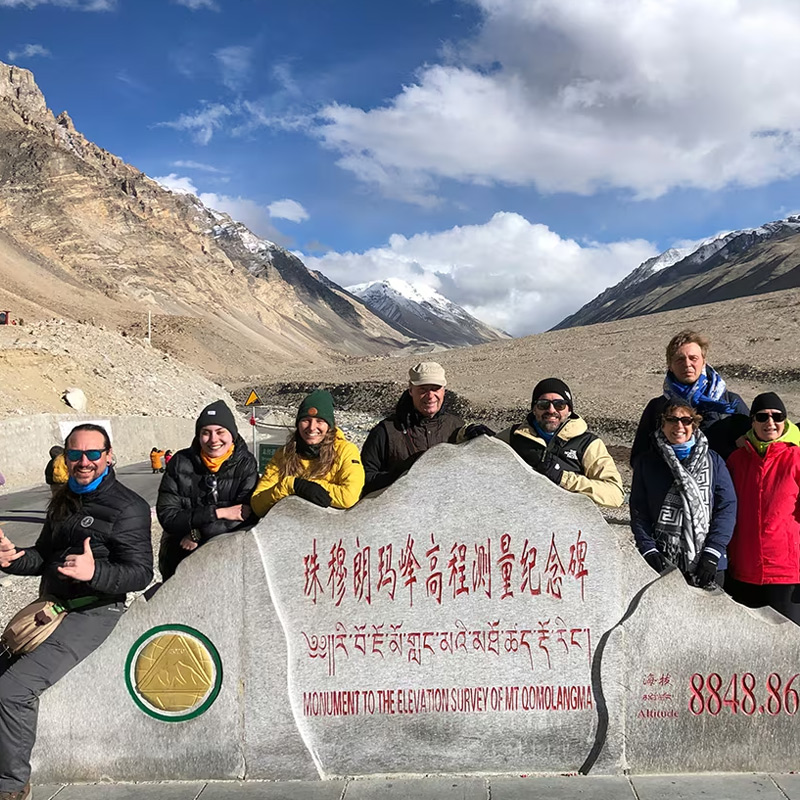
Rongbuk sits at about 4,980 m at the end of the Everest road, a few kilometers below the Base Camp visitor area, and is often described as the highest monastery in the world. The monastery is small — half an hour covers it — but Everest’s north face fills the valley behind its white chorten. Where you sleep depends on the itinerary and altitude tolerance: some trips stay in the tent guesthouses near Base Camp (about 5,200 m), some use the Rongbuk Hotel (4,980 m), and others descend to the Vienna in Tingri (about 4,300 m).
Sakya Monastery: The Seat of the Sakya Tradition
Sakya lies about 130 km southwest of Shigatse, its fortress walls striped in grey, white and red — the colors of the tradition it heads. Founded in 1073, its abbots governed Tibet for much of the 13th and 14th centuries. The great hall hides a library wall some 57 meters long and 11 high, holding tens of thousands of volumes.
Western Tibet: Monasteries Beyond Shigatse
Beyond Shigatse the highway runs on toward Ngari, and the monastery map thins out: Dirapuk and Zutulpuk belong to the Kailash kora, reached on foot, and Tholing waits at the end of the longest road of all, in Zanda, heart of the old Guge kingdom.

Dirapuk Monastery: The North-Face Monastery of the Kailash Kora
Dirapuk sits at about 5,210 m on the first night of the Kailash kora, the 52-km circuit from Darchen. It is a small working monastery rather than a sightseeing stop, but its position is extraordinary: the north face of Kailash rises directly across the valley, close enough to fill the evening sky. Trekkers reach it on day one; the teahouses beside it provide the night’s simple beds.
Zutulpuk Monastery: The Miracle-Cave Monastery Past Dolma La
Zutulpuk waits at about 4,790 m on the second night, after the crossing of Dolma La at about 5,630 m, the high point of the circuit. The monastery is built around a cave associated with Milarepa, Tibet’s poet-saint — the name means “miracle cave.” From here the trail eases back to Darchen; most trekkers finish by early afternoon of day three.
Tholing Monastery: The Ancient Monastery of the Guge Heartland
Tholing is the westernmost site on this map, standing in Zanda County of Ngari, roughly 1,300 km by road from Lhasa — and one of the oldest, founded in 996 by the Guge king Yeshe-Ö, whose patronage made it a center of translation and Buddhist learning. The murals in its surviving halls count among the oldest in Tibet, and the monastery pairs naturally with the Guge Kingdom Ruins at Tsaparang nearby. It belongs only to far-west itineraries of two weeks or more.
Tibet Monastery Routes: Which Sites Can You Combine?
The thirteen sites chain together along the classic routes — pick the one that matches your days.
Lhasa Monastery Route: Jokhang, Drepung, Sera and Ganden
Three to four days in Lhasa covers the cluster: Drepung in the morning and Sera’s debates in the afternoon of the first sightseeing day, then the Potala Palace and Jokhang the next, with Ganden as a half-day add-on. The Lhasa cluster normally requires no additional travel permit beyond the Tibet Travel Permit.
Lhasa–Gyantse–Shigatse: The Main Monastery Corridor
With six to seven days, the southern road adds the corridor monasteries: Pelkor Chode in Gyantse and Tashilhunpo in Shigatse. The expressway brings you back to Lhasa in about three hours; rail schedules for the Lhasa–Shigatse line are listed on the China Railway booking service.
Lhasa–Gyantse–Shigatse–Everest: Monasteries Along the EBC Route
The eight-day classic continues from Shigatse over Gyatso La to Tingri and Rongbuk — Jokhang, Drepung, Sera, Tashilhunpo and Rongbuk on one line, the route of our 8-day Lhasa Everest Base Camp tour. The drive back runs through Dinggye and Sakya Ancient Town rather than retracing the highway, so Sakya fits inside the same eight days.
Lhasa–Everest–Namtso: Adding the Great Lake
The Namtso version runs a different Lhasa programme: Potala Palace, Jokhang Temple and the Barkhor, without the Drepung and Sera day. From Shigatse and Everest it returns by Tashilhunpo, then heads north to Namtso, the great lake on the northern road — the arc of our 8-day Lhasa Everest Namtso tour.
Lhasa–Kailash–Guge: Western Tibet Monastery and Heritage Route
Thirteen- to fifteen-day journeys carry the map all the way west: Dirapuk and Zutulpuk on the three-day kora from Darchen, then Zanda, where the Guge Kingdom Ruins and Tholing’s ancient halls stand close together. That western arc is the one our 15-day Lhasa Everest Kailash Guge Namtso tour runs. Ngari routes generally require additional permits beyond the Tibet Travel Permit — including the Aliens’ Travel Permit and, depending on the itinerary, military and border-area permissions — all arranged by your operator.
Choosing a Tibet Monastery Route by Trip Length
If the routes above still feel abstract, start from your calendar — each trip length has a natural monastery set.
3–4 Days: Focus on Lhasa
Stay in the Lhasa cluster: Jokhang, Drepung and Sera, plus Ganden with a fourth day. These days double as your acclimatization anyway.
7–10+ Days: Add Gyantse, Shigatse and Everest
The corridor opens up here: the southern road west adds the Gyantse and Shigatse monasteries, and the classic eight-day run folds Rongbuk in beyond them. The Namtso version adds the great lake north of Lhasa, and the Everest return through Dinggye brings Sakya into the same frame. The monastery set stays close across these options — what changes is the finish.
12–15 Days: Add Western Tibet
Two weeks opens western Tibet: the Kailash kora, where Dirapuk and Zutulpuk break the three days, then Zanda, where Tholing and the Guge Kingdom Ruins close the journey. Commit only if the 5,630 m pass and teahouse nights genuinely appeal — this tier is a pilgrimage, not a sightseeing extension.
Frequently Asked Questions
Tibet Monasteries Map FAQ
How many monasteries should I include on a first trip to Tibet?
Three to five major sites is usually enough for a first trip. Jokhang, Drepung and Sera cover the Lhasa essentials; Tashilhunpo and Rongbuk can be added naturally on the road west. More stops are possible, but the value of a monastery visit often comes from having enough time inside rather than collecting names.
Which monastery is closest to Mount Everest?
Rongbuk Monastery, just before the Base Camp visitor area at the end of the Everest road. Most standard Everest itineraries pass it, and the north face behind its white chorten is one of the classic images of Tibet.
Do foreign travelers need a permit to visit monasteries in Tibet?
Foreign passport holders need a Tibet Travel Permit to travel in Tibet, arranged through a licensed operator as part of an organized itinerary. Many popular monastery routes — Lhasa, Samye, the Gyantse–Shigatse corridor and the regular Everest route — generally no longer require a separate Aliens’ Travel Permit under the current adjustment, while Ngari and some remote or border areas still require additional permits. Confirm the exact documents for your itinerary before departure; this was checked in October 2026.
Can I visit Dirapuk and Zutulpuk monasteries without trekking?
No — both sit on the Kailash kora and are reached on foot, on days one and two of the standard three-day circuit from Darchen. Non-trekkers typically wait in Darchen or at Lake Manasarovar viewpoints.
Is photography allowed inside Tibetan monasteries?
Photography rules vary by monastery and by area within a monastery. Exteriors and courtyards are often easier to photograph, while interior chapels may prohibit photography or require permission — follow the posted signs and staff instructions, and ask before photographing monks or local pilgrims. Rules can change, so check on arrival. Beyond the lens: walk koras clockwise and take hats off inside chapels.
Where do these figures come from?
Road distances from Lhasa are approximate one-way planning figures compiled in October 2026 and rounded. Founding dates, site descriptions and opening details draw on published regional and monastery sources and on our own site checks; opening hours, photography rules and debate schedules are set locally and can change, so treat them as indicative. Permit requirements follow the position at our October 2026 check: the regular route generally no longer needs a separate Aliens’ Travel Permit, while Ngari and some remote or border areas still require additional documents arranged by your operator.